
Relocating to Nashville: A Step-by-Step Move Timeline
Nashville Real Estate Jessica Simpson, Associate Broker Moving Nashville Homes Team at Compass July 2, 2026
Nashville Real Estate Jessica Simpson, Associate Broker Moving Nashville Homes Team at Compass July 2, 2026
Thinking about relocating to Nashville can feel exciting right up until you start asking the hard questions. When should you get preapproved, how much time should you set aside for your search, and how do you plan a move when you may still be living in another city or state? The good news is that Nashville’s market in 2026 is more balanced than it was a few years ago, which gives you more room to plan carefully and make smart decisions. This step-by-step timeline will help you map out your move with more confidence. Let’s dive in.
If you are relocating to Nashville, timing matters just as much as budget. In May 2026, Redfin reported a median sale price of $474,716 in Nashville, with homes averaging 70 days on market. In Davidson County, the median sale price was $488,535 and homes averaged 59 days on market.
That pace is more measured than the pandemic-era market. Greater Nashville REALTORS® has also described the region as moving into a more balanced phase, with rising inventory and more room for negotiation for buyers. Still, well-located, move-in-ready homes can attract strong interest, so a steady plan is better than a casual one.
Before you start picking favorite homes online, focus on what your move will actually cost. That means looking beyond the down payment and thinking about closing costs, moving expenses, and an emergency cushion after you arrive.
The research also shows that many loan types require at least 3% down, while closing costs vary based on the home price, loan type, and location. If you are deciding whether to rent first or buy right away, this is the right stage to compare those financial tradeoffs carefully.
One of the biggest mistakes relocators make is assuming every area around Nashville fits the same budget. In reality, county-level price differences across Middle Tennessee are wide enough to change your options in a major way.
Greater Nashville REALTORS® reported Q1 2026 median residential prices of $499,990 in Davidson County, $446,470 in Rutherford County, $453,200 in Sumner County, $530,000 in Wilson County, $1,065,000 in Williamson County, and $359,950 in Dickson County. If you are flexible on location, comparing these areas early can help you match your budget to your goals.
Financing has its own clock, so your home search timeline should line up with it. Preapproval letters commonly expire after 30 to 60 days, which means getting one too early can create extra work if your move date shifts.
This matters even more when rates and contract dates are part of the equation. The research notes that rate locks are typically available for 30, 45, or 60 days, so it helps to coordinate your lender conversations with your search window and expected closing timeline.
A Nashville-area move is not just about the house. It is also about how your daily routine will work once you get here. If you are considering a suburb or an outlying county, your commute deserves real attention before you commit to an area.
WeGo offers commuter bus service from several surrounding areas into downtown Nashville, including Murfreesboro, Smyrna/La Vergne, Gallatin/Hendersonville, Dickson, Springfield/Joelton, Clarksville, and Spring Hill/Franklin. These express services run in defined rush-hour blocks, so it is smart to treat commute planning as part of neighborhood selection.
For some relocators, rail may also be part of the picture. WeGo Star serves the East Corridor, running from Lebanon Station to Riverfront Station in downtown Nashville.
That option will not work for every buyer, but it can be useful if your home search includes communities along that route. Riverfront Station does not include parking, though it does connect to WeGo bus service, so that detail is worth factoring into your planning.
Inventory growth has made it easier for buyers to slow down and compare options. Greater Nashville REALTORS® reported February 2026 inventory at 12,315, up 12% year over year.
That does not mean every home will wait for you. It does mean you may have more breathing room to compare areas, revisit your must-have list, and narrow in on the neighborhoods that best fit your lifestyle, budget, and commute.
By this point, you should move from broad research to a focused shortlist. That may include a few Nashville neighborhoods, a couple of suburban communities, or a mix of city and commuter-friendly options depending on your goals.
This is where local guidance becomes especially valuable. A relocation search tends to move faster and with fewer surprises when you already know your price ceiling, your commute boundaries, and the features you are not willing to compromise on.
Even in a more balanced market, strong homes can move quickly. The current averages of 70 days on market in Nashville and 59 days in Davidson County suggest you usually have more time than buyers did during peak bidding-war years, but pricing and condition still matter.
Well-priced, move-in-ready homes can attract serious attention. If you find a home that checks the right boxes, it helps to be ready with your preapproval and a clear offer strategy rather than waiting too long.
A preapproval letter is often required by sellers before they will seriously consider an offer. It is also important to remember that preapproval is not the same as final loan approval.
If your relocation timeline stretches or changes, check your letter dates and update documents as needed. Staying current can help you avoid delays when the right property appears.
Once you are under contract, the inspection window becomes one of the most important checkpoints in your move. It is not just another task to cross off the list.
The research recommends scheduling a home inspection as soon as possible after choosing a home so there is time to resolve issues. If your contract is contingent on a satisfactory inspection, that period gives you a real decision point if the results are not acceptable.
For relocators, inspection timing matters even more because you may be coordinating the process from a distance. You want enough time to review findings, ask questions, and decide what comes next without adding unnecessary pressure to your move.
A clear plan during this stage can help you stay grounded. Instead of seeing the inspection as a formality, treat it as the moment to confirm that the home still makes sense for your timeline, budget, and comfort level.
As closing approaches, document review becomes a priority. The lender must provide the Closing Disclosure at least three business days before closing, and that gives you time to review key numbers and terms before signing.
This stage is especially important if you are moving from out of state and managing lots of logistics at once. Give yourself space to review the Closing Disclosure, promissory note, mortgage, and related paperwork carefully so there are no last-minute surprises.
If you are not yet in Tennessee, remote logistics may matter a lot. Tennessee authorizes remote online notarizations through approved notaries using audio and visual technology.
That does not guarantee every closing can be completed fully remotely, but it does mean there is an official framework in place when the lender, title company, and document package allow it. If remote signing would make your move easier, ask about that option early instead of waiting until the final week.
Before signing, schedule a final walk-through. This gives you the chance to confirm that agreed repairs were completed and that anything the seller agreed to leave is still in the home.
For a long-distance move, this step is easy to underestimate. It is one of the best ways to make sure the property matches expectations before the transaction is finalized.
The final days before your move are about making the landing smoother. That includes confirming your move date, organizing address changes, and reviewing your final paperwork so everything is easy to access once you arrive.
This part of the timeline may sound simple, but it often feels busiest. A little organization here can make your first week in Nashville much less stressful.
Relocating to Nashville is easier when you break it into clear steps instead of trying to solve everything at once. The 2026 market gives many buyers more room to compare homes and negotiate thoughtfully, but good planning still makes all the difference.
If you want a smoother move, start early, build your budget carefully, and line up your financing, commute research, search strategy, and closing logistics in the right order. When you have experienced local guidance and a clear timeline, the whole process feels more manageable.
If you are planning a move to Nashville or the surrounding suburbs, Jessica Simpson can help you build a smart, neighborhood-focused plan from search to closing.
Market updates, design trends, and lifestyle tips from your local luxury experts.
Murfreesboro Real Estate
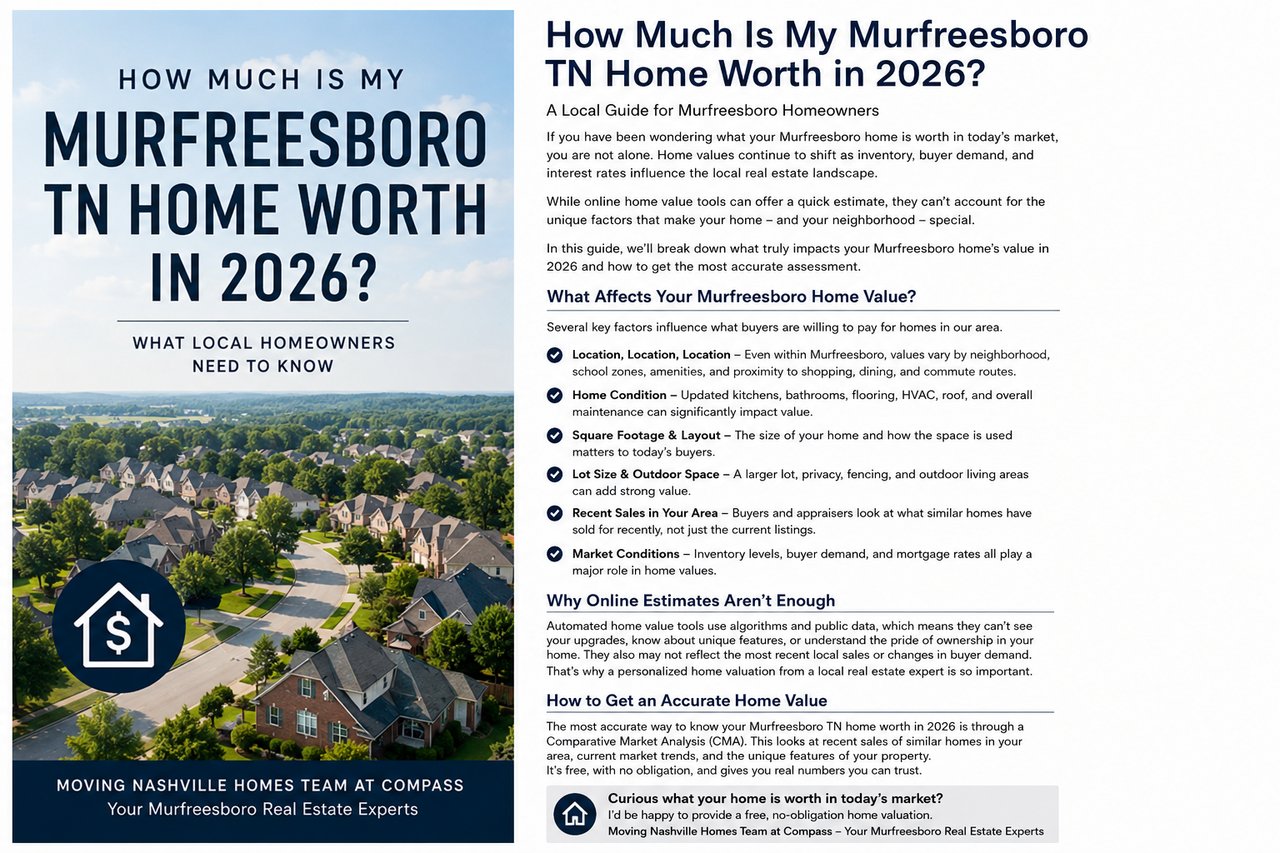
What Murfreesboro Homeowners Should Know Before Choosing a Listing Price

Murfreesboro Real Estate
Home Prices, Inventory, Mortgage Rates & What Buyers and Sellers Need to Know
Franklin Real Estate
Practical tips for simplifying your move, reducing upkeep, and finding a Franklin home that better fits your current lifestyle.

Franklin Real Estate
Explore Franklin’s distinct housing markets, from the historic downtown core and established neighborhoods to master-planned communities and newer construction.
Mt. Juliet Real Estate
Compare the benefits, costs, timelines, and lifestyle considerations of buying a newly built home versus an existing home in Mt. Juliet.
Nashville Real Estate
A practical relocation timeline covering home searches, financing, neighborhoods, schools, moving logistics, and settling into Middle Tennessee.
Experience personalized service, market expertise, and unmatched results.